The 10 best tips to improve your time management
It’s high time to take back control and start working smarter, not harder. There are simple and effective time management tips to help you do just that.
Published on
August 13, 2026

It’s high time to take back control and start working smarter, not harder. There are simple and effective time management tips to help you do just that.

It is high time to take back control and work smarter instead of harder. Fortunately, there are simple and effective time management tips.
Bringing structure to the chaos, making meetings shorter and more efficient, scheduling work deadlines with ease, maintaining focus and concentration during interruptions? These tips are designed to help you manage your time better and lower your stress levels.
Want to read this article later in a handy PDF format?
Download the e-book with all the tips from this article here
Time blocking is a technique where you reserve specific time slots for specific tasks. By dividing your workday into defined periods for different activities, you can focus better on a task without distractions.
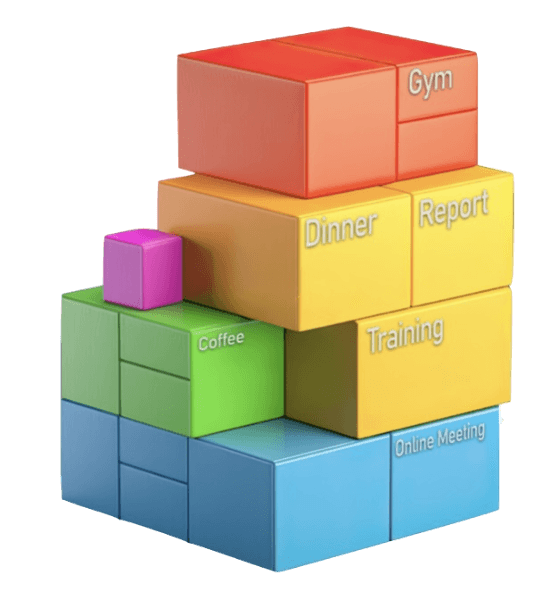
Furthermore, it helps you prioritize and avoid putting tasks on the back burner. Instead of just having a to-do list with all your tasks and appointments mixed together, time blocking takes it a step further by reserving a specific time slot for each task. This allows you to minimize distractions.
To use time blocking effectively, start by creating a daily or weekly schedule in which you organize your tasks into different time slots. Prioritize important and long-term tasks and ensure you are realistic when planning the time you allocate to each task.
Also, don't forget to include short breaks between time slots to stay fresh and maintain your concentration.
A simple yet effective life hack is the 2-minute rule. If a task takes less than 2 minutes to complete, do it right away. This could be emails that can be answered quickly, small adjustments to a document, or a quick phone call. By handling these small tasks immediately, you prevent them from piling up and overwhelming your to-do list.
It also allows you to spend more time on more complex and important tasks. Suppose you receive an email in which a colleague asks you to share a file. If sharing the file takes less than 2 minutes, do it immediately instead of putting it off. This saves you time and prevents you from forgetting the task.
Small tasks can sometimes subconsciously take up a lot of mental space, especially if they are left undone and pile up. By handling them immediately, you prevent them from becoming a source of constant worry. This helps you to think more clearly and focus on more important tasks, which reduces your overall stress level.
Completing small tasks gives you an immediate sense of satisfaction and control. It creates a positive feedbackloop, where each completed task motivates you to keep going and achieve more. This sense of accomplishment can self-confidence boost and give you the energy to tackle the rest of your to-do list.
Distractions can seriously hinder our productivity. To focus on your work, minimize the distractions around you. Put your phone on silent or in do-not-disturb mode, block access to social media, and ensure your workspace is tidy.
If you have colleagues who frequently interrupt you, clearly communicate your working hours and when you do not want to be disturbed. If you have tasks where distractions are unavoidable, use smart hacks like the Pomodoro technique, where you work in short intervals followed by short breaks.
If you are often interrupted by calls and notifications, put your phone on silent or in do-not-disturb mode during your working hours. Also, keep your phone out of reach to reduce temptation. Ensure your workspace is organized and clean so you are less distracted by clutter.

It is a technique that revolves around dividing your working time into defined intervals, usually 25 minutes, followed by short breaks. The name "Pomodoro" is Italian for "tomato" and refers to the classic tomato-shaped kitchen timer.
Here is how it works:
The Pomodoro technique helps you stay focused and productive by breaking your work down into manageable chunks.
The 80/20 rule states that the ratio between the input and output of your work is rarely, if ever, balanced. For example: 20% of products generate 80% of revenue.
Applied to your job, it means that about 20% of your efforts produce 80% of the results. Learning to recognize that 20% and focusing on it is the key to making the most effective use of your time.
Here are a few quick tips for applying the 80/20 rule.
Take a good look at the people around you. Twenty percent of your colleagues, employees, or team members likely provide 80% of the support and satisfaction you need. They are the source of your success. Take good care of them.
Also, take a critical look at your tasks and your work. Ask yourself: "What yields the most results? Which 20% of my work should I focus on?"
It is a way to optimize your time management based on the tasks that yield the most for you or help you reach your goal. By applying the Pareto principle, you can focus on the tasks that contribute most to your professional success and have the greatest impact.
Emails can quickly become overwhelming, so it is essential to keep your inbox under control. This leads to more peace of mind, productivity, and satisfaction. Zero inbox means an empty mailbox at the end of every workday.
Here is how to do it:
Go through your inbox and assess every email. If an email takes less than 2 minutes to answer or handle, do it immediately. If an email requires more time, flag it and schedule a specific time block to handle it later.
After you have processed each email, archive it or move it to specific folders. For example, create folders such as "Action Required," "Waiting for Response," or "To Follow Up."
By clearing your inbox, you prevent emails from piling up and becoming a chaotic mess.
An empty inbox gives you a clear overview of your tasks and obligations. You don't have to scroll through a pile of emails to see what you still need to do. An empty inbox also ensures that you don't miss important messages or forget to reply.
More info: Productive with Outlook
While being a team player is important, it is also good to know when and how to set boundaries. How often do you find yourself saying 'yes' to others just to avoid an uncomfortable situation?

Both at the office and in our personal lives, we are frequently confronted with all sorts of requests, invitations, or unnecessary obligations that we would much rather skip, yet find difficult to decline. As a result, our own priorities are often compromised; they are both time and energy drains.
Boost your overall well-being and say 'no' more often. This leaves you with space for the things that truly matter.
If you do agree to do something for someone else, negotiate a deadline that allows you to complete the task without sacrificing your own goals. A healthy dose of assertiveness can undoubtedly work wonders.
It can be difficult to say 'no', especially if you are a people-pleaser. But every time you say 'no' to something that doesn't contribute to your goals, you are actually saying 'yes' to yourself and your priorities.
With some practice and self-awareness, you can learn to say 'no' more effectively and protect your time and energy for the things that really matter.
Need help? Assertive Communication Course
Poorly run meetings are a waste of time, not just for you but for the other participants as well. Ensure that your presence at a meeting serves a purpose and that you aren't just meeting for the sake of meeting.
Productive meetings? Here is what you can do:
When scheduling a meeting, block out time before and after it in your calendar and avoid back-to-back meetings. There is a good chance a meeting will run over, and that will cause problems—and stress—for your next appointment.
You likely have things to prepare before you head out, and afterwards you may need to look something up, note down action items, or forward information.
So, block out at least an extra fifteen minutes before and after the meeting. Don't need that extra time? It will certainly come in handy as a chat, coffee, or rest break in your busy day.

Procrastination is a common phenomenon with various causes. One of the most significant factors is perfectionism. People put off tasks because they fear they won't meet their own (excessively) high standards. That fear of potential criticism or disappointment holds them back from getting started.
In addition, a lack of intrinsic motivation can play a role. If people are not motivated by a task because they consider it boring or uninteresting, they will often put it off.
Finally, a feeling of being overwhelmed can cause people to push tasks aside. When a task seems too large or too complex, it can be very tempting to keep putting it off.
HOW TO TACKLE PROCRASTINATION?
1. Make tasks manageable: Break large tasks down into smaller, achievable steps. This makes it easier to get started and keeps motivation high.
2. Eliminate distractions: Identify and reduce potential distractions in your work environment, such as social media, emails, or unnecessary notifications. Create an environment that is conducive to focus and productivity.
3. Reward yourself: Set rewards for completing tasks or reaching milestones. This can boost your motivation and help you avoid procrastination.
There is no doubt that multitasking is bad for the quality of our work: it increases the chance of errors and also means we get our work done more slowly. One of the reasons we do it anyway is because we are addicted to the stimuli and the mental reward we get when we are presented with a small or easy task. Just think of reading an email or the many notifications on your smartphone.
Every time we do that, we experience a new stimulus, which activates dopamine (the happiness hormone) in our brains. You get an instant reward. And because our brains love quick rewards, we are constantly looking for the next stimulus. Our brains are triggered by these impulses, and our concentration immediately takes a nosedive.
How do you stop multitasking? Try the tips below.
Checking your phone as soon as you wake up means you hop from one stimulus to the next, and before you know it, half an hour is gone. Start your day with your most important priorities and wait at least an hour before checking your phone. Think of it as a digital detox.
Turn off email, chat, and social media notifications while you are working. Consider blocking out time in your calendar to focus on important tasks. Let your colleagues know so they don't disturb you. It's best to make agreements about this (for example, if I'm wearing headphones, I don't want to be disturbed).
Clutter causes distraction and mental unrest. Organize your workspace so you can optimally focus on one thing at a time. Put your phone and anything else you don't immediately need out of sight so they don't demand your attention.
If you work with a team, remember that you are not alone. Don't be afraid to ask for help and look at what you can pass on or delegate to others. This not only helps reduce your own workload but also engages your team members and helps develop their skills.
Even if you are not in a management position, there are certainly tasks that others can assist you with or even take over. Perhaps a colleague has some spare time, or team members might appreciate the opportunity to use their specific expertise or skills.
In any case, communicate expectations and deadlines clearly. Ensure that the person you are handing the task to fully understands what is expected. Show that you trust their abilities and give them the space to carry out tasks in their own way.
More info: Effective delegation
These tips are a good start. But real change happens in practice, together with others facing the same challenges. In the time management training from Expert Academy, you will learn in one day how to set priorities, establish boundaries, and work productively without stress.
-> View the time management training
In this practical handbook on Time Management, you will receive tips on managing your calendar, delegating effectively, and setting priorities. You will learn how to deal with time-wasters, achieve concrete goals, and design a strong, efficient system to work in a more results-oriented and efficient way.
The result: you will work much more efficiently and achieve a better work-life balance!
Ready to get started right away? Take the time management course.